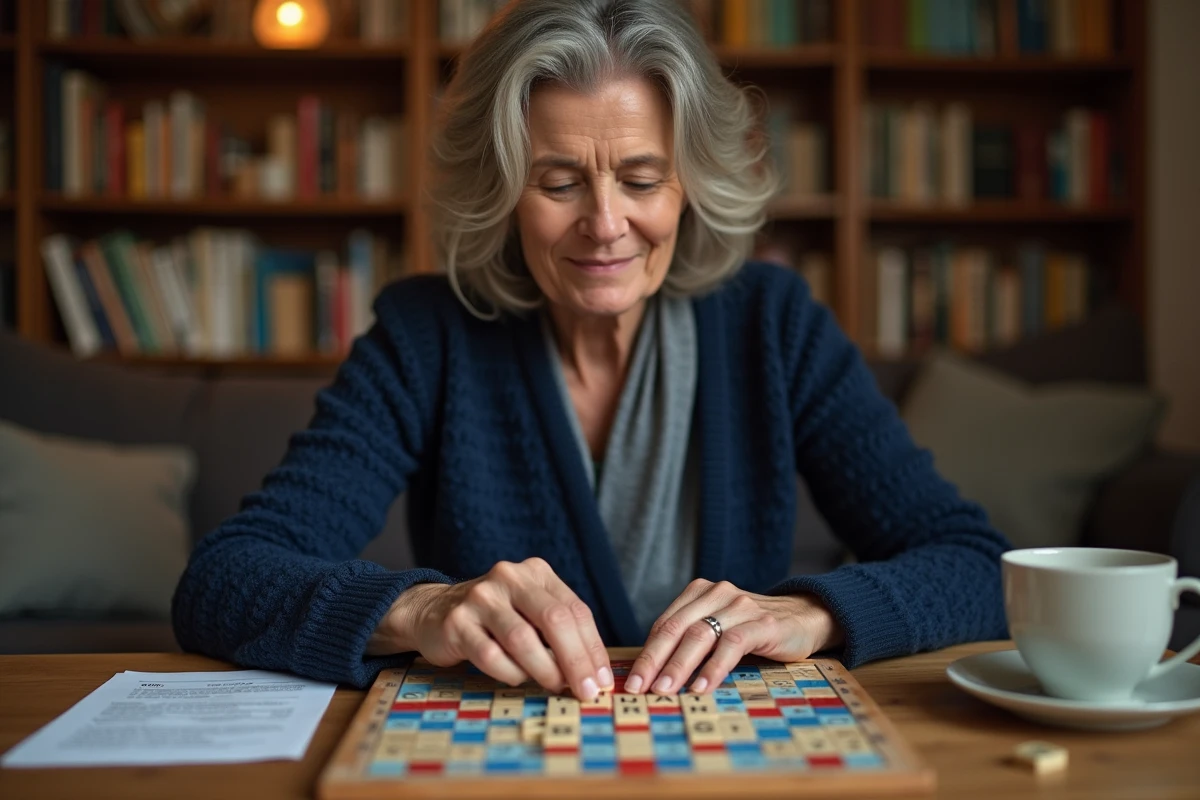
Online Scrabble on Clicmouse pits the player against an adjustable artificial intelligence. Each game takes place on a classic 15×15 board, following the same placement and scoring rules as the physical game. The difference lies in the speed of execution and the ability to replay immediately, making it a regular training ground to work on precise mechanics.
ODS Dictionary and Word Verification on Clicmouse
One point that most online Scrabble guides overlook: the dictionary integrated into Clicmouse is not always aligned with the latest version of the Official Scrabble Dictionary (ODS). Club players report discrepancies between the words accepted on the platform and those validated in competition.
This difference has a direct impact on training. A word learned and practiced on Clicmouse may be rejected during a tournament if the reference version has changed. To avoid this discrepancy, systematically cross-checking played words with the ODS remains the only reliable method.
When a player seeks to maximize their scores in Scrabble with Clicmouse, this parallel verification allows for building a vocabulary that is truly usable in competition, not just on the platform.
Two-Letter Words and Rare Letters in Scrabble
Two-letter words are the most underestimated scoring lever. Quentin Mallégol, world Scrabble champion, puts it clearly: you must memorize the allowed two-letter words, especially those that contain rare letters.

Words like WU, XI, QI, KA, or AY allow you to place high-value letters (W, X, K, Y) on multiplier squares, even when the draw seems blocked. On Clicmouse, where the AI does not leave bonus squares vacant for long, knowing these words makes the difference between a few-point move and one that exceeds twenty.
Training against the computer allows you to test these short words in various configurations. Each game generates a different board, forcing you to spot lateral openings and supports on already placed words.
Building Extensions from Short Words
A two-letter word placed parallel to an existing word often creates two or three words simultaneously. This mechanic, called support or overlap, multiplies points without consuming many letters.
On Clicmouse, the AI systematically exploits this technique. Observing its moves after each game is a learning exercise in itself. Noticing how the computer uses a simple “QI” placed at the edge to open an entire line provides transferable reflexes for real games.
Duplicate Strategy vs. Free Play Strategy on Clicmouse
Existing articles rarely address the fundamental difference between the game modes. In duplicate, each player has the same draw and seeks the best possible move. The goal is pure score maximization each turn, without worrying about the opponent’s draw.
In free play against the AI, the logic changes. Managing the letter bag becomes a strategic parameter. Keeping an S or a wildcard for a future move, blocking an area of the board to prevent the computer from scoring, exchanging letters at the right moment: these decisions do not exist in duplicate.
- In duplicate, prioritize the most profitable move each turn, without reserving letters for later
- In free play, monitor the remaining letters in the bag to anticipate the AI’s probable draws
- Adjust the level of the computer on Clicmouse to work on a specific mode without excessive frustration
A player who trains solely in free play develops blocking and management reflexes but may lack calculation speed in duplicate. The opposite is also true. Alternating between the two modes on the platform allows for working on both registers.
Multiplier Squares and Placement in Online Scrabble
The Scrabble board contains double word, triple word, double letter, and triple letter squares. Their exploitation determines the score gap between two players with equivalent vocabularies.
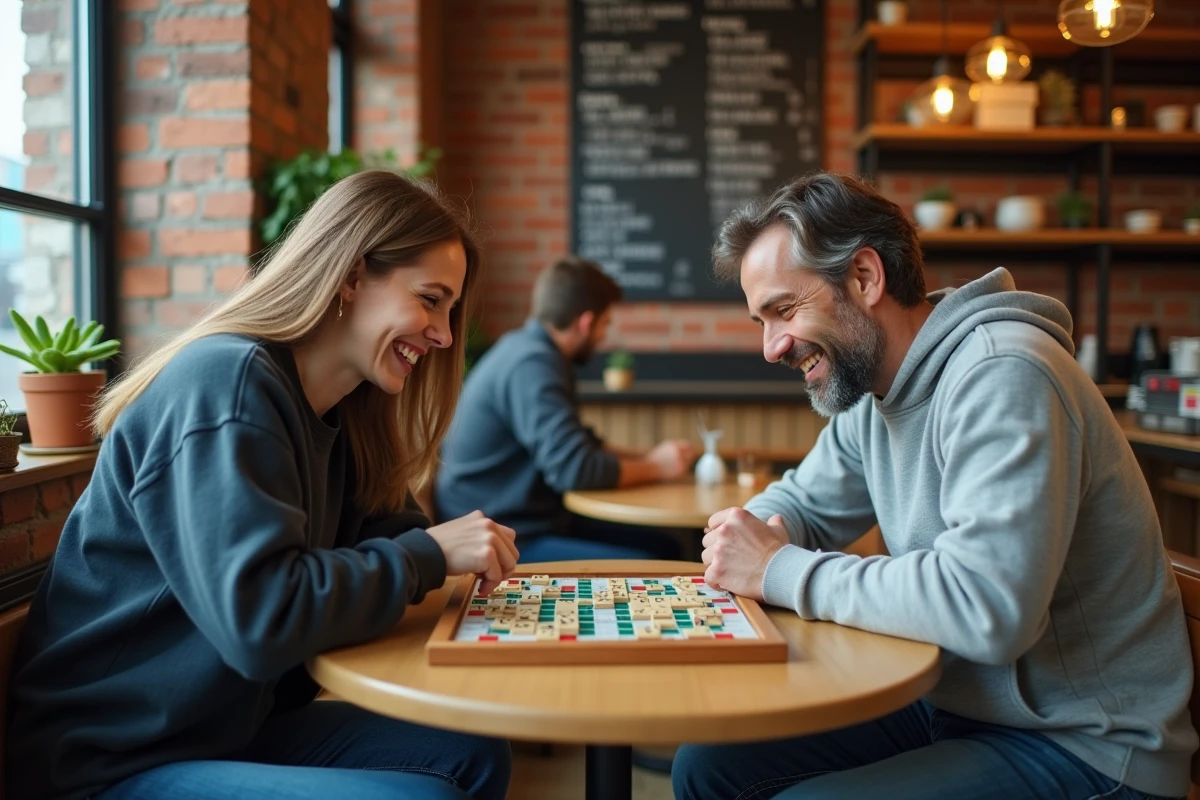
On Clicmouse, the high-level AI systematically targets triple word squares. Leaving an opening to these squares is like offering points. The basic rule in defense: before placing a word, check if the move opens direct access to a triple square for the opponent.
Combining Rare Letters and Multiplier Squares
Placing an X or a W on a triple letter square while forming a word that crosses a double word square produces disproportionate scores relative to the number of letters used. These combinations are rare, but spotting them becomes more natural with regular practice.
- Keep high-value letters (W, X, Y, K, Z) as long as a multiplier square remains accessible
- Do not hesitate to play a short word if the position on the board is optimal
- Avoid placing these letters on neutral squares, even to get rid of a difficult draw
- Analyze the AI’s moves after the game to spot missed combinations
Platform Regulations and Limits of Automated Assistance
One point often overlooked: many online tournaments prohibit the use of automated aids during ranked games. Word generators, integrated assistants, move suggestions, all of this can be considered cheating according to the platform or league regulations.
Clicmouse, used as a solo training tool, poses no problem. The risk arises when a player uses an external generator during a ranked game on another platform, relying on habits formed during assisted training sessions.
Checking the regulations of each competition before participating avoids sanctions. Training on Clicmouse then makes perfect sense: it allows you to memorize words and mechanics without depending on a tool during the game.
Scoring in Scrabble relies less on the breadth of vocabulary than on the ability to place the right word in the right place, with the right letters, at the right time. Clicmouse provides a framework to repeat these situations. The rest comes down to the consistency of training and the rigor of verification with the ODS.