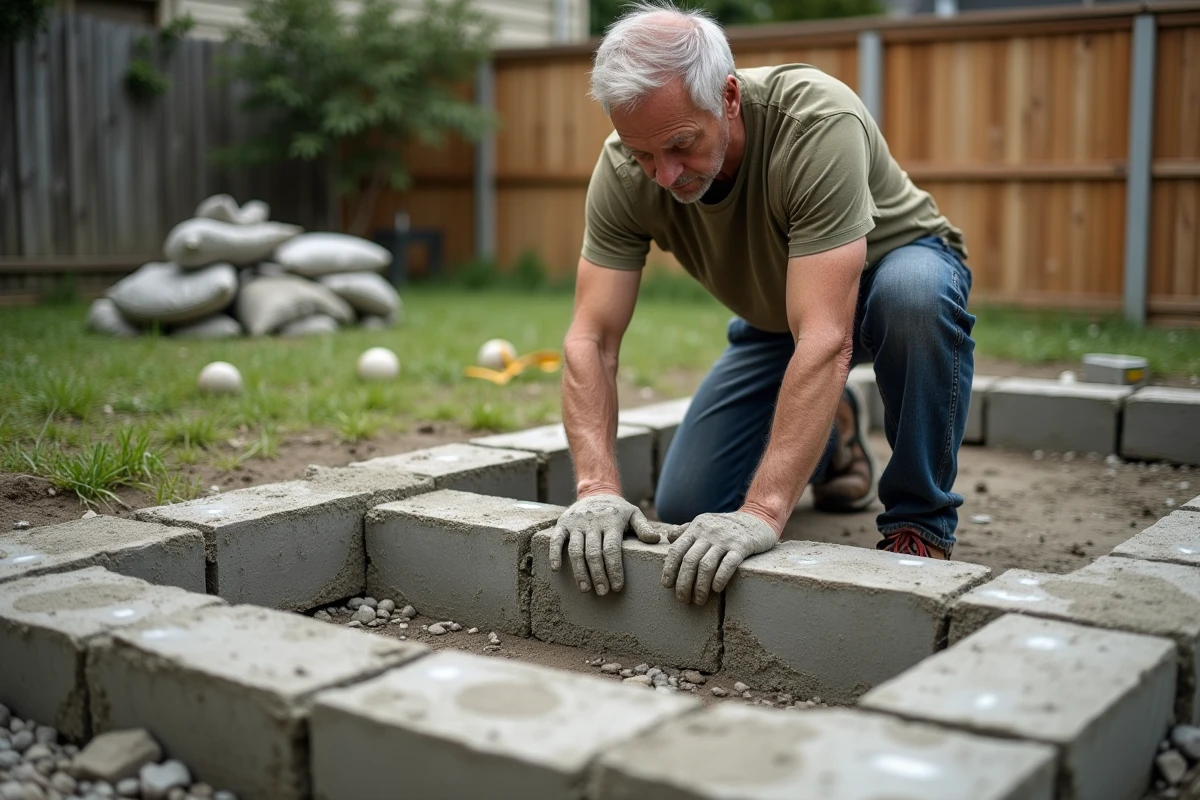
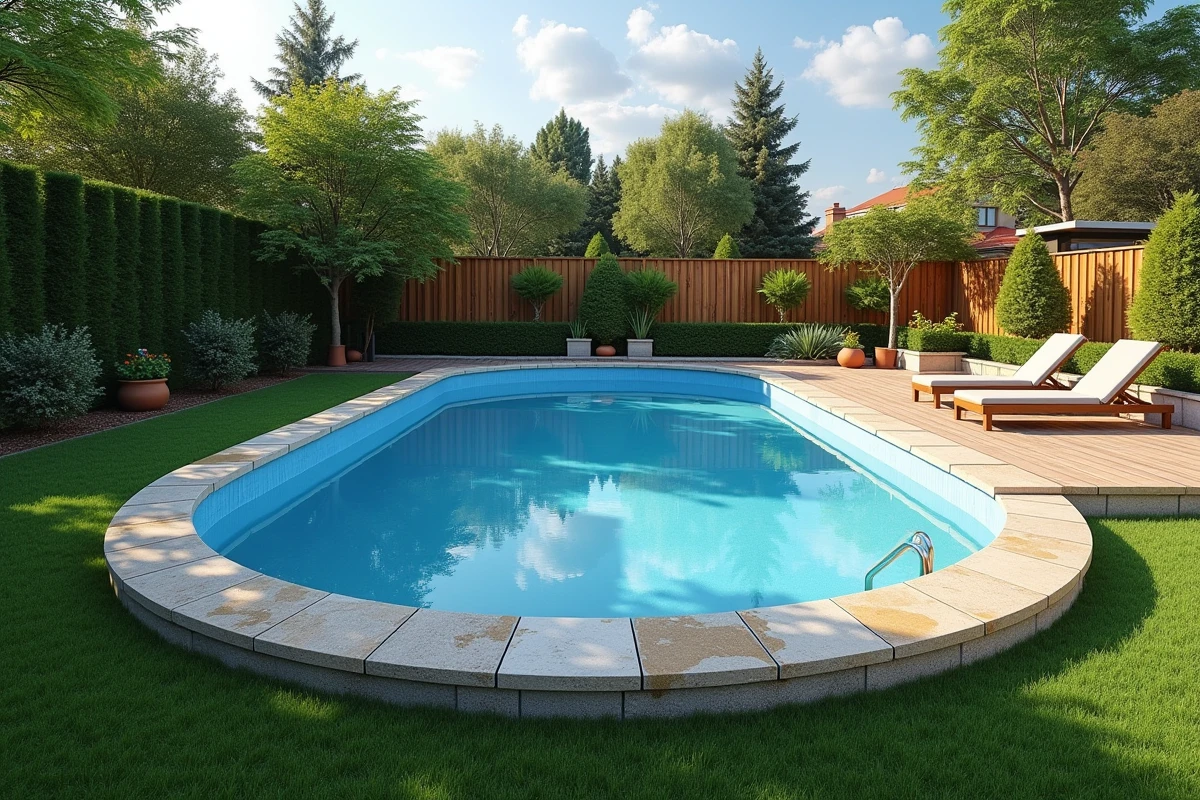
An above-ground concrete block pool is based on a simple principle: building masonry walls above the ground level, without digging a deep excavation. This type of pool attracts self-builders because concrete blocks remain an accessible material and the installation technique is familiar to most masons.
The French regulatory framework imposes formalities based on the pool’s surface area: no declaration below 10 m², prior declaration between 10 and 100 m², and a building permit beyond 100 m².
Reinforcement and load-bearing: what changes when the pool is above ground
An inground pool benefits from the pressure of the backfill against its walls. In an above-ground configuration, the walls receive no external counter-pressure: all hydrostatic pressure acts outward. The stresses on the masonry are therefore radically different.
Documented sites by professionals show that vertical and horizontal reinforcement must be strengthened compared to a traditional pool. Reinforced concrete columns (stiffeners) are poured into the cavities of the concrete blocks at regular intervals, and horizontal ties connect everything at mid-height and at the top. Without this reinforcement, the risk of cracking under water pressure increases significantly.
The bottom slab deserves the same attention. It must support the weight of the water without resting on soft or poorly compacted soil. A drained gravel base, a properly sized welded mesh, and vibrated concrete form the minimal foundation. Neglecting this step compromises the stability of the entire structure, as differential settling cracks the walls as soon as the pool is filled.
Before building an above-ground concrete block pool, it is essential to size the reinforcement considering the actual water height and the nature of the soil, not just replicate a standard plan found online.
Hollow block or formwork block: which choice for an above-ground pool
The traditional hollow block remains the cheapest material. Its cavities receive the filling concrete and vertical rebar, but the implementation requires more rigor: each cavity must be completely filled to ensure structural strength. Partial filling creates invisible weak points.
The formwork block, on the other hand, is designed to be fully filled with concrete. Its H or U shape guides the pouring and facilitates the passage of reinforcements. The unit cost is higher, but the installation time decreases and the result is more uniform.
For an above-ground pool, where the walls work in cantilever, the formwork block offers a better guarantee of uniform filling. Feedback from the field varies on this point: some self-builders achieve excellent results with traditional hollow blocks, provided they vibrate the filling concrete for each row. The choice depends on the level of masonry experience and the available budget.
Technical room for above-ground pool: an underestimated constraint
The filtration system, pump, electrical box, and treatment devices must be sheltered. For a masonry above-ground pool, specialized guides emphasize the need for a technical room built on a concrete slab, even for a small pool.
The absence of a technical room or a simple tarpaulin shelter exposes the equipment to freezing in winter, overheating in summer, and constant humidity. Feedback from owners indicates that this flaw generates more breakdowns, corrosion on fittings, and difficulties during winterizing.
Planning the location of the technical room from the outset allows for optimizing pipe lengths. The shorter the pipes, the less the pump has to work, and the more reasonable the electricity consumption remains. A solid structure (concrete block or treated wood) with sufficient space to move around the equipment is the functional minimum.
Equipment to protect in the room
- Filtration pump and sand filter (or cartridge), which are the heart of the hydraulic circuit and cannot tolerate freezing
- Waterproof electrical box with dedicated differential circuit breaker, mandatory for safety
- Treatment device (electrolyzer, dosing pump, or pH regulator) and stock of chemicals, to be isolated from direct moisture
Waterproofing and finishing of the above-ground concrete block pool
Concrete block is not waterproof by nature. There are two main options to ensure the pool’s waterproofing: the liner and the waterproofing coating (such as resin or water-repellent mortar).
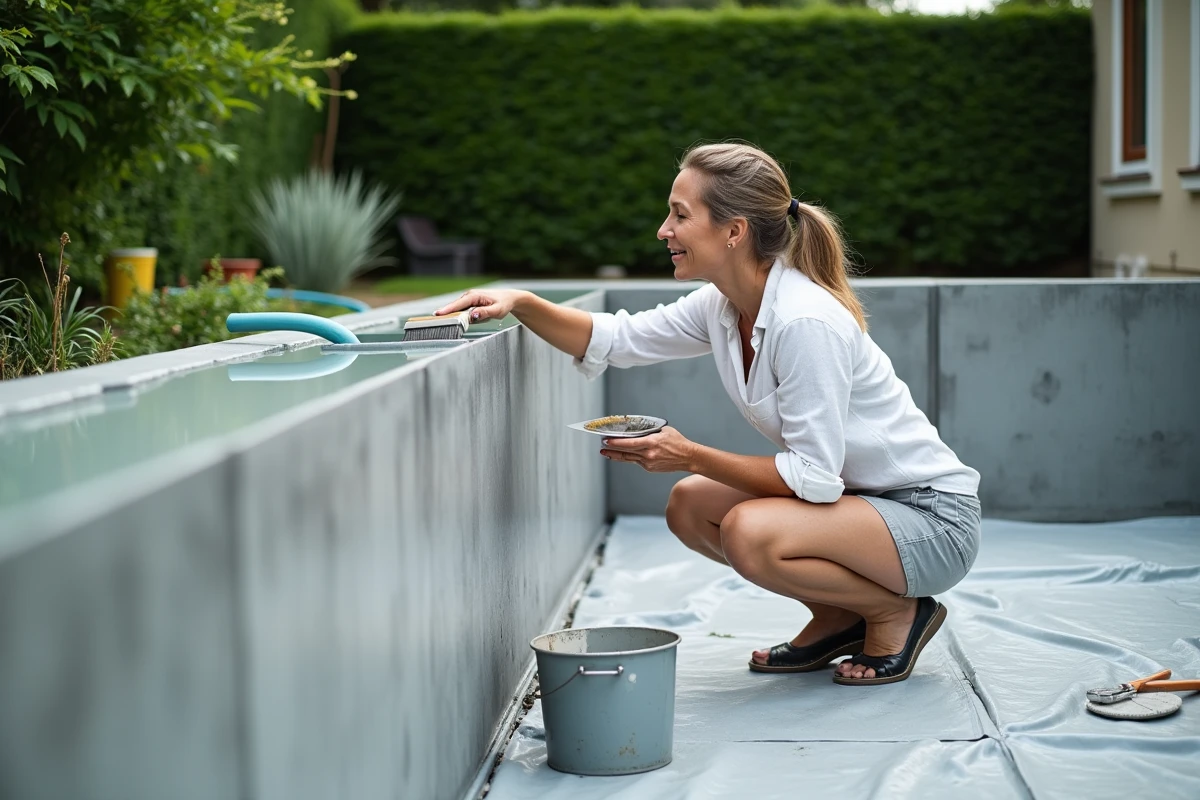
The liner laid on felt remains the most common solution in self-construction. It tolerates small surface irregularities and can be replaced after about ten years of use. A smoothing coat on the walls is essential before installing the liner, to avoid premature perforations at points of contact with the raw concrete block.
The waterproofing coating applied directly to the masonry offers a more durable finish, but its implementation requires rigorous surface preparation and several layers. This option is better suited for experienced DIYers or projects assisted by a professional.
Points of caution on sealing fittings
Skimmers, return jets, and bottom drains pass through the masonry wall. Each sealing fitting is a potential weak point for waterproofing. Sealing is done in water-repellent mortar, with a silicone joint suitable for permanent contact with water. Testing the waterproofing fitting by fitting before full filling prevents the need to empty the pool to fix a leak.
- Provide a counter-nut and an O-ring on each wall penetration to compensate for micro-movements of the structure
- Align the sealing fittings before installing the last rows of blocks, not after
- Check the water level over 48 hours after partial filling to detect any loss before the exterior finish
Building an above-ground concrete block pool remains an accessible project as long as the structural steps are not taken lightly. Reinforcement, block choice, technical room, and waterproofing form a chain: if one link fails, the entire pool suffers. It is better to extend the preparation phase by a few days than to redo a cracked wall after the first season.